Israeli Wine Fair – Rosh Pina (May 3, 2013)

May 13, 2013

Last year I missed the Tal Shahar Home Wineries Fair because it coincided with the Jacob’s Ladder Festival. This year I was able to attend the Israeli Wine Fair for precisely the same reason. Jacob’s Ladder is held at Nof Ginosar, and the Israeli Wine Fair took place a short 20 minute drive away in Rosh Pina.

IMG_2574a

So at the cost of a few missed music performances (I really had wanted to see the Arava Riders), I headed off to the Baron Gardens in the historic center of Rosh Pina. I arrived early with the intention of staying no more than two and a half hours so as not to miss too much of Jacob’s Ladder. Since I only planned to spend time with the handful of wineries that were new to me, and possibly try a few new offerings from wineries I already knew, I naively thought that would be possible. Furthermore, I skipped all four of the Ramot Naftali wineries since I’ll be going to their wine event in a couple of weeks. So it seemed perfectly reasonable that I’d be done in the time I’d allotted. And for a while everything seemed to proceed according to plan. I arrived shortly past 10:00 as things were just getting underway, and by about 12:00 I was nearly done. Just one or two more and I’d be on my way. But somehow, just a few minutes later, it was 14:00. I really have no idea how that happened. Never mind.

On to the show.

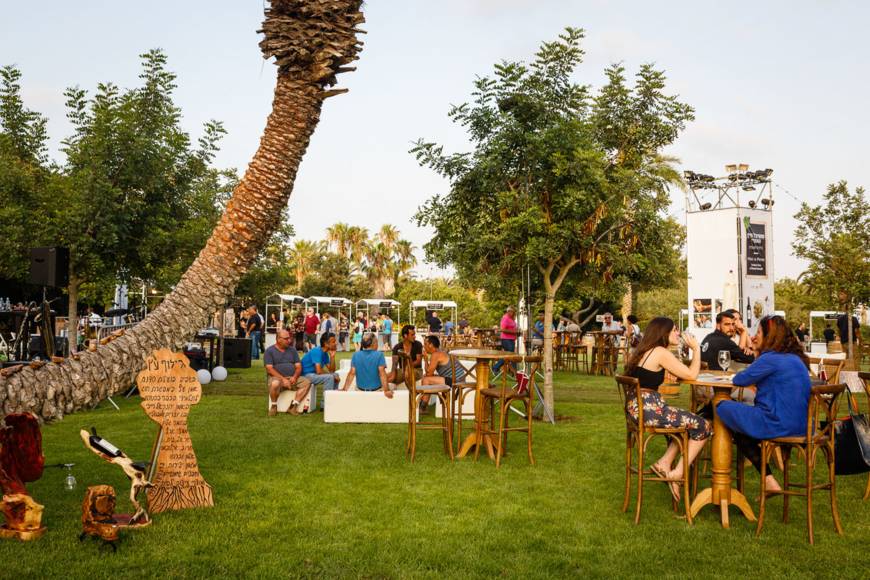
First of all the venue. The Baron Gardens in Rosh Pina are lovely. The gardens are landscaped with terraces and the wineries’ tables were spread around under trees on three levels. There was also shade netting overhead to keep things cool during the heat of the day. The atmosphere was very pastoral and relaxing, with pleasant music playing in the background.

IMG_2577a

As I mentioned before, I arrived early. The advantages were that it was still cool and not yet crowded. The disadvantages were that not all of the tables were manned (personed?) yet, and most of the red wines had not had time to breathe sufficiently.

Generally speaking there was not a bad wine in the lot, though some were quite superior and others more mediocre (IMHO).

I started off with the Levi Winery, which was a completely new one for me; before this event I had never even heard of them. Kobi Levi, the winemaker, told me that the 2011 wines he was presenting were from his first commercial vintage of about 3,000 bottles. Kobi’s father and grandfather are both vintners, and Levi’s wines are made from the family’s own grapes. I tasted two 100% varietals from the 2011 Bareket series – a Cabernet Sauvignon and a Merlot. The former is what I call a medium-medium-medium wine – medium fruit, medium body, medium finish, all in all a nicely balanced and not overpowering Cabernet that was just right for the warm weather. Unfortunately, the Merlot just wasn’t ready to drink yet even though Kobi had aerated it using a neat device from the Brookstone catalog. I’ve actually thought about making something similar from a cheap aquarium air pump, but it wouldn’t look very elegant on the table. Anyway, despite the aeration, the Merlot was overly fruity and rather flat. I’m sure it improved with time.

Levi’s wines are all certified Kosher, and starting with the 2013 vintage, some of them will be organic as well.

Next I visited the Stern Winery‘s table. I have met Johnny Stern before but had never had the chance to try his wines. Now I can say that they are superb. I started with the 2012 Sauvignon Blanc. For me, the gold standard of Sauvignon Blanc in Israel is from the Gush Etzion Winery. It’s crisp, very dry, grassy, not too fruity, and has substantial body – just the way I like. While Stern’s Sauvignon Blanc did not threaten the reign of the Gush Etzion, it is a very pleasant wine indeed. For those who prefer their SB lighter and fruitier than I, Stern’s will be perfect.

After the SB I tried Stern’s 2011 Cabernet Franc (100%), made from grapes grown in the upper Galilee. Full bodied and not overly fruity, I found the wine to be a bit too bitter and astringent. The bitterness probably subsided with time after opening and will undoubtedly decrease with more time in the bottle, as will the astringence. Given another year and a half or so in the bottle it will probably be excellent.

On to two blends – both from 2010. Rotem is a Bordeaux-ish blend of Cabernet Sauvignon (52%), Merlot (19%), Cabernet Franc (16%), and Petit Verdot (13%); Peleg is rather different, with 51% Shiraz blended with 29% Cabernet Sauvignon and 21% Merlot. Johnny told me that the Rotem blend consistently wins gold medals at the Eshkol Hazahav and Terravino competitions, and I can understand why. It is full bodied, well balanced, and just a pleasure to drink. Despite the excellence of the Rotem blend, I actually liked the Peleg even more; not surprising since I love a good Shiraz. What is surprising is that the Shiraz did not dominate the blend, as often happens when the percentage is so high. This wine, on the other hand, is very well balanced and has a softness to it that particularly appealed to me. At NIS 80 I considered this to be good value for money, and I took a bottle – my only wine purchase of the day.

Stern is currently producing some 18,000 – 19,000 bottles a year and they plan to increase that to ~25,000 with the 2013 vintage. Johnny told me that most of the increase will be white wines.

The Galileo Winery is another new one for me. The name of the winery is a mish-mash of Gil (the winemaker), Gali (his wife), and Galil (where the grapes grow). The winery is located in Kibbutz Dan in the Golan (another G) on the banks of the Dan river. Sounds like a place I should visit.

Gil had two wines to taste and I tried them both. The first was a 2010 Cabernet Sauvignon which I found to be very enjoyable and not too heavy, with a nice finish. The second wine was a 2010 blend called Jupiter, consisting of Cabernet Sauvignon, Merlot, Syrah, and Petit Verdot. The blend was a bit rounder and heavier than the varietal CS with a more substantial finish. Of the two, I preferred the blend.

Jascala was also new to me, though the winery has been around since 2003 – I guess I just don’t get around enough. At their table was one white, one rosé and one red. All were good. The 2012 Sauvignon Blanc was crisp, medium bodied , and fruity, but not overly so. At 14% the alcohol content was high, but not obtrusive.

The 2011 Rosé was made from Cabernet Franc grapes, possibly my first rosé from that variety. The wine was fresh tasting and fruit forward but not overpowering.

Jascala’s red at this fair was their 2008 Aida blend of Cabernet Sauvignon (71%), Petit Verdot (17%), and Merlot (12%). My notes say only “very very pleasant blend,” and I would have taken one but for the price; NIS 180 is just out of my range.

At the Netofa Winery‘s table I tried two Chenin Blancs, a 2011 that was barrel aged for eight months and an unoaked 2012.  Not surprisingly, the unoaked wine was crisper and fresher tasting, and on this particular occasion I preferred it. Different venue, weather, state of mind, etc., and I might have preferred the fuller bodied 2011.

Netofa, which is a Kosher estate winery,  also had a 2011 red blend called Tinto made from Touriga and Tempranillo grapes. Winemaker Pierre Miodownick explained to me that this is the same blend he uses to make Netofa’s port style wine. The Tinto blend is barrel aged for ten months, and the result is a very complex, interesting, and fine wine.

IMG_2579b
This post is getting very long so I’ll try to finish up.

Unfortunately, I only found two Viogniers at this event, one each from the Ortal and Carmel wineries. I say unfortunately because I think that Viognier is an under appreciated variety, with a number of excellent offerings produced in Israel. Considering the relatively low number of Viogniers I’ve seen on international wine websites, I believe that Israel can become a significant player with this wonderful variety, thus improving Israel’s standing as a serious producer of quality white wines.

To me, the Ortal Viognier was unremarkable, with medium body and not much character. One must, however, keep in mind the number of wines, including more than a few full-bodied reds, I had tasted before getting to this one. Also, others who tried this Viognier liked it a lot, so this is just my personal taste. At NIS 110, this was also the most expensive Viognier I’ve come across.

The Carmel Viognier, from their Appellation series, was aged sur lie for six months, and was much more to my taste. At under NIS 50, I consider it to be a good value.

I also tried Ortal’s red Tel Shifon. This blend of  Cabernet Sauvignon, Merlot, and Syrah was rather to my liking, with medium to full body and a nice long-ish finish.

By the time I reached the Yiftah’el Winery’s table, I was pretty saturated, so my notes are somewhat vague. Yiftah’el is another estate winery, growing all of their own grapes; current production is about 10,000 bottles annually.

I tried four Yiftah’el wines, starting with their 2012 Rosé called Samuk (meaning blush). This Rosé, a blend of Sangiovese (80%) and Merlot, is pleasantly fruity, but despite no residual sugar, it had a false sweetness that did not appeal to me.

The first red I tried was a 100% Sangiovese that I enjoyed very much, despite high astringence.

Finally I tried two Petite Syrah varietals from the 2009 and 2007 vintages respectively. To my tired palate the 2009 was rough and a bit bitter. The 2007, which had spent 24 months in oak, had a pleasantly earthy aroma, a deeper color, and was considerably more balanced. I have been told by a number of winemakers that it is quite challenging to make a varietal Petite Syrah due to its overpowering character. With their 2007 offering, I would say that Yiftah’el has quite successfully tamed the Petite Syrah.

The last wine I sampled was not from a winery per se, but the product of a winemaking course at the Ohalo College in Katzrin. The students of the course tended and harvested the grapes, and were involved in every stage of the winemaking process, making this 2010 Cabernet Sauvignon rather unique. I would not say that this was an outstanding Cabernet, but as a group effort for first timers it was very respectable. Ohalo’s table was manned by Ari Erle, winemaker of the Bat Shlomo Vineyards, and wine consultant. Ari, who is originally from California, lives in Givat Nili, which is very nearby to my home, so I expect I’ll be running into him more often.

To end my visit, I tasted the cider offerings of Boutique Hagail – one apple and one pomegranate. I had never had a pomegranate cider before, and as I suspected, it was too sweet for me. The apple cider was more to my liking. For this event Boutique Hagail was offering a too-good-to-refuse 1 + 1 deal (one bottle each of pomegranate and apple cider) for just NIS 10. I took 2 + 2 to take back to the gang at Jacob’s Ladder, where I arrived (safely) in time for some of the afternoon performances.

I would like to thank the organizers of the Israeli Wine Fair for putting on such an enjoyable event and for inviting me to attend. I had a marvelous time.

White Wine Festival at Herzlia Marina This Week

May 7, 2013

For the fifth year in a row, the Herzlia Marina will be hosting a White Wine Festival, feature white wines, rosés and sparkling wines from Israel and around the world.

The festival will be held on Wednesday and Thursday, May 8 – 9, at 18:00 – 23:30. According to the forecast, the weather will be rather hot, so it should be just right for whites and bubblies.

Entry costs is NIS 65. That gets you unlimited tastings and you can keep the glass.

Here’s the official announcement.

5th Annaul White Wine Festival

A complete list of exhibitors and wines is on the Grape-Man website here.

I attended this festival for the first time last year (see my posting here) and had quite a good time, so I’m looking forward to going again.

Hope to see you there.

Wine and Ch… (Apr 25, 2013)

April 28, 2013

… chicken.

A few months ago Dina met Hagai Ben Asher at a networking meeting.

After working with hi-tech start-ups for many years, Hagai decided, about a year ago, to pursue his passion to be an artisan blacksmith. Along with custom designed and hand crafted railings, fences, gates, artistic ironwork, etc., Hagai builds meat smokers for home use and restaurants. At the networking meeting Hagai announced an upcoming event to be held at the Asambia venue in Binyamina, at which he would be preparing smoked chicken.

IMG_2458a

Since Asambia is only a ten minute walk from our house, and since it sounded like a nice way to have dinner and try something new, we decided to go. There would also be wine tastings from the Fusion Global Winery, making this event almost irresistible. To add to the lure, the price was right. Portions of chicken were NIS 30, and wine was another NIS 30. For tastings, that may be high, but for unlimited wine to accompany dinner, it’s rather reasonable.

Fusion Global follows a rather different and unique paradigm from other wineries. (Even the traditional jargon may not be strictly applicable; for want anything better I’ll stick with the terms “winery” and “winemaker.”) Though based in Israel, the wines come from all over. Chief winemaker Doron Yitzhaki travels to the great wine regions of the world to select wines from which he creates Fusion Global’s blends. The winery’s website provides a good bit more information, including a page of links to articles about the winery and its wines.

When we arrived at Asambia we began with the wines since they were presented at the entrance while the food was inside. Eynat Yitzhaki, Doron’s wife, explained about the winery’s concept and briefly described the wines.

IMG_2451a

A word about Asambia. Located in the historic center of Binyamina, Asambia provides a rustic style setting for small gatherings and events. With wooden tables under cover and open areas among vineyards and olive trees, the atmosphere is welcoming and relaxed.

IMG_2463a

I started with the whites. The first was a 2011 French Gewurztraminer that was aromatic and pleasant, but overpoweringly sweet. As a desert wine it might have succeeded, but for me this was not a wine to accompany a savory meal.

The second white was a 2011 semi-dry German Riesling. Definitely more delicate than the Gewurztraminer, but still not my choice for dinner.

Of the two reds I first tried the 2005 Australian Shiraz-Merlot blend. The second red had just been opened, so I set aside a glass to try later after it had had a chance to breathe and open a bit.

Inside, Hagai had prepared two styles of smoked chicken – 0ne spicy and one herbed; we tried one of each.

IMG_2455a

I started with the spicy smoked chicken and it paired well with the Shiraz-Merlot blend. The chicken, which had been smoked over citrus charcoal for about 3-1/2 hours, was juicy, peppery, and very tasty, though only mildly smokey. The wine had a deep purple color, was fruity and very full bodied. There was a hint of bitterness that was not unpleasant, and which dissipated with time as the complexity developed. The most enjoyable aspect of this blend was its long outstanding peppery finish, which perfectly complemented the spiciness of the chicken.

The herbed chicken, though smokier in flavor, was less interesting than the spicy one, rather lacking in any character of its own, though I did enjoy its smokiness. I suppose the degree of smokiness has to do with the position of the chicken in the smoker and the time spent in it. A combination of smokier and spicier would probably be most to my liking.

By this time I was hoping that the second red, a 2005 Spanish Tempranillo-Garnacha blend, would be ready to drink. As with the chicken, the second red wine was less to my taste as well. To me it started with an earthy, not entirely inviting aroma, pleasant fruitiness, medium body, and an unremarkable finish. Keeping in mind that this was 2005 wine that had been open less than half an hour, I suspected that those impressions were premature, and indeed over the next 20 minutes, the wine improved considerably, becoming more full bodied. In all fairness, Dina enjoyed the Tempranillo-Garnacha blend much more than I.

So for me, the winners of the evening were the spicy smoked chicken and the Australian Shiraz-Merlot blend.

After we had finished eating, Dina & I had the pleasure of meeting Hadar Dor-Onn who, together with his wife and children, owns and operates Asambia. In addition to that endeavor, Hadar is a fifth generation vintner whose forbears grew grapes for Baron Edmund de Rothschild. It turns out that Hadar was one of the first in Israel to plant Viognier and Malbec, but that story will have to wait for another time.

Note: Rogov (z”l) reviewed Fusion’s red wines in 2009, and his notes are by far more professional than mine. Rogov recommended a prime drinking window for these wines through 2011.

First (but not last) Visit to Eyal Winery

April 22, 2013

Now that we have moved to Binyamina I have lots of new wineries to investigate. Aside from the Big Three, there are two in Atlit, two in Kerem Maharal, three in Zikhron, three in Binyamina, one in Givat Ada, one in Amikam, four in Givat Nili, two in Pardess Hanna, and probably a few I don’t know about.

Since I was off work for all of Pesach, it seemed like a perfect opportunity to visit some of these wineries. While I routinely drink non-Kosher Israeli wine year round, I am rather strict about Pesach, so to make sure there’s no risk of hametz, I stick to Kosher wines during Pesach. This rather limited my plans since there is only one Kosher boutique winery in the area – the Eyal winery in Givat Nili.

So I called Eyal one afternoon and he invited me to come by that evening.

Givat Nili is just about 13 km from where I live so it was a quick journey. On the way I saw a gorgeous moonrise over Givat Ada and actually managed to get a decent picture.

IMG_2319a

When I reached the Eyal winery I saw what looked like a very nicely laid out courtyard, though it was hard to tell in the dark, with a small building that housed the winery’s visitor’s center. Inside I found proprietor/winemaker Eyal Ohayon waiting for me behind the beautiful hand made wooden counter.

IMG_2324a

By way of background Eyal explained to me that his family has been growing grapes in the area for three generations. Most of their grapes were sold to other wineries, but some were always reserved for making wine for their own use. With the 2007 vintage Eyal started making more “serious” wines, and he formally opened the winery in 2008. The following year, for the 2009 vintage, Eyal converted the winery to Kosher production.

Today Eyal makes about 7000 bottles annually  all from grapes grown in the family’s vineyards, in and around Givat Nili. Currently Eyal is offering six wines, of which I tasted three.

We started off with a white blend of Chardonnay and Emerald Riesling called Blanko. Before tasting, Eyal “warned” me that he makes his wines to satisfy his own personal taste; if your taste is the same as his you’ll love his wines, otherwise maybe not so much. Eyal likes his whites somewhat sweet, so that’s how he makes the Blanko. The Chardonnay is completely dry, with a hint of oak from four months in used barrels, but the Emerald Riesling is anything but, resulting in a semi-dry blend. The flavors in the wine are full and pleasant, but a bit too sweet for me. Having said that, I believe this wine will be quite successful, and I would probably enjoy it more as a desert wine.

Of the reds, there are four varietals – Cabernet Sauvignon, Merlot, Shiraz, and Carignan, and a Cab/Merlot/Shiraz blend called Shani, named for the color and after Eyal’s sister-in-law/graphic artist. I got to taste the varietal Merlot and the Shani blend. The Merlot is a very very fruit forward mouth filling wine with very soft well integrated tannins. Even shortly after opening the Merlot was very enjoyable. The Shani blend had a lot in common with the Merlot varietal, which is not surprising as it is 40% Merlot, with the remainder being 35% Cabernat Sauvignin and 25% Syrah. I could definitely taste the Syrah, and it was especially evident in the aroma of the wine, but the Cabernet was not at all pronounced. As is frequently the case, I enjoyed the blend more than the varietal.

IMG_2325a

Against my protestations, Eyal opened new bottles of all three of these wines for me to taste. Then he decided that I should take the two open reds home with me. This was extremely generous as both bottles were about 3/4 full. When I got home, I put vacuum stoppers in both bottles and put them in the fridge hoping that they would keep for Shabbat dinner when we would be having a lot of guests.

When Friday evening rolled around I took out the bottles and found that they had improved in the two days since they had been opened. The extreme fruitiness had subsided a bit, making the wines more balanced. Everyone enjoyed these wines with Dina’s marvelous Shabbat dinner (I helped but it was mostly her). Quite fittingly, my brother-in-law, Eyal, was particularly fond of these wines. One day I hope to take Eyal to meet Eyal so he can try the rest of Eyal’s wines.

Eyal (the winemaker) told me that he has wine and cheese evenings at the winery with live music, so I’m definitely looking forward to another visit.

Of course, all of Eyal’s wine’s can be purchased at the winery, and you can also find them at the Livyatan meat shop in Beit Hananya, the Gan Shmuel supermarket, the Sitonaut Binyamina bottle shop behind the train station in Binyamina, and on the wine list at Koya in the Caesarea industrial area.

15 March 2013 – 5th Annual Home Wineries Fair at the Sorek Winery

April 3, 2013

This was the fourth time I attended the home wineries fair organized by the Soreq Winery in Moshav Tal Shachar. Last year it was held on the same Friday as the Jacob’s Ladder Festival, so unfortunately I had to miss it (the kids wouldn’t hear of not going to Jacob’s Ladder). So my record is four out of five – not bad.

If you’ve read my past postings (here and here), you know that I particularly enjoy this event. The winemakers are all there; they are happy to tell their stores and they really want to know what you think of their wines.

According to the list, there were 20 wineries in attendance this year, and I managed to taste wines from most of them. Quite a few of the wineries have been at this fair in past years, and I was pleased and gratified that several of the winemakers actually remembered me (even more remarkable since I missed last year).

As in the past, I found that the overall quality of the wines has improved since the last time I attended. A good example is the Dani winery. I met Dani five years ago at the first Home Wineries Fair, and have tasted his wines over the years at each fair. While I like Dani very much, his wines were never quite to my taste. This year was a different story. Dani’s 2010 Cabernet Sauvignon is full bodied and well integrated with a nice finish. It was one of my favorite wines at the fair and I gladly bought a bottle. At present, Dani makes about 700 bottles a year, but I wouldn’t be surprised if he increases the quantity considering the improving quality of his wine.

Argov is another winery that participated previously. This year Argov brought three wines. A Cab/Merlot/Petit Verdot blend that I found very pleasant, a 100% Cabernet Franc that was a bit rough for my taste, and a 100% Petite Syrah varietal. As is characteristic of the variety, this Petite Syrah is quite powerful. Even after 18 months in new American oak barrels, the wine maintained its character beautifully and is not dominated by the oak at all. Apparently I am not alone in my opinion of this wine as it took a gold medal at the Terravino competition.

In recent years Carignan has been making a wonderful comeback in Israel. Carignan used to have a terrible reputation; it was mostly grown with very high yields and used to produce cheap barely drinkable wines. I used to call it Israel’s Dego red, because it was ok with spicy Italian food but not much else. Then, a few years ago, several winemakers discovered that old Carignan vines, when pruned for low yields, can produce some outstanding wines, and now there are several exceptional Israeli Carignans. At this years Home Wineries Fair there were no fewer than four varietal Carignans, and a number of blends containing various amounts of Carignan.

Among the varietals, my favorite was the 2011 Carignan from the Shakutai Winery in Mazkeret Batya. The grapes are from old vines in the moshav, and although the wine is relatively young, it is eminently approachable, with medium body and finish. At NIS 50 I consider this wine a good deal.

Of the blends with Carignan, I was particularly impressed with the flagship Hamivtsar blend from the Mivtsar Atlit Winery, comprising 40% Cabernet Sauvignon and 20% each Shiraz, Carignan, and Petit Verdot. To me, this was one of the best wines at the fair. Despite the unusual blend of varieties, Hamivtsar is a very well integrated wine with no overpowering flavors and a very long and very pleasing finish. I considered this a good buy at NIS 70 so I took two.  Mivtsar Atlit was also at the Home Wineries Fair two years ago, but I wasn’t able to taste their wines that time as there was nothing left by the time I got to their table. This year I arrived early and I’m glad I did.

The only Kosher wines I tried at the fair were from the A.G. Winery. I had tasted and enjoyed their wines of earlier vintages, so I was not surprised that I liked them a lot this time too. This year A.G. brought three blends from their The Vines series, all  of which won silver medals at Terravino. My favorite was the 2009 The Vine Aroma, an 80/20 Cabernet/Merlot blend, aged for 24 months in oak. Full bodied with very well integrated tannins, this wine is a perfect match for the best steaks. The only thing that kept me from buying a bottle was the price; at NIS 120 it was just out of my budget.

The only white wine I found this year was a semi-sweet Viognier from the Mor Alon winery. While too sweet for me, I’m sure this Viognier will appeal to those who prefer their whites not so dry.

The turnout for this year’s Home Wineries Fair seemed quite a bit lighter than in past years; I suppose it had to do with the hot weather, though  I must say that I hardly noticed the heat. For those of you who stayed home because of the heat – your loss. I had a great time. I certainly hope next year’s Home Wineries Fair will again be scheduled on a date that works for me.

As always, many thanks to Nir, Inbar, all the winemakers, and everyone who once again made this event so much fun.

Vitkin Winery – 9 Mar 2013

March 22, 2013

I think the last time I visited the Vitkin Winery was at least four years ago, and probably longer. Now that we have moved to Binyamina, it is much more convenient, and this event was scheduled at a very convenient time for me, on a Saturday evening.

When I arrived, there were 40 or 50 people in attendance, and the tastings were set up in stations, using barrels spread around the winery’s courtyard as tables.

The stations were arranged in the recommended tasting order, starting with the whites. The first was a 2011 Riesling (100%) that was very light with pleasant hints of yellow grapefruit. This is an off dry wine, and though it’s not entirely to my taste I believe it will probably have a broad appeal among those who prefer their whites less than bone dry.

IMG_2160a

The second white was Vitkin’s 2012 White Israeli Journey, an interesting blend of Viognier (30%), Gewurtztraminer (30%), French Colombard (20%), and Rousanne (20%). Considering the relatively high percentage of Gewurtzraminer, I expected some sweetness, but there was none. Instead, I found this wine to be well balanced, refreshing, and crisp, actually reminding me of a very dry Sauvignon Blanc, even though there isn’t any in the blend. I enjoyed this wine a lot.

At the next station I tasted the 2011 Red Israeli Journey and the 2010 Pinot Noir. The former is a pleasant, though to my taste, unremarkable, blend of Carignan, Syrah, and Cabernet Franc. The latter is a different story altogether. First a confession. All my experience with Pinot Noir is with Israeli wines, giving me nothing to compare with. Winemakers have told me time and again, that Israel’s climate is less than ideal (to put it mildly) for growing Pinot Noir, so for all I know, all Israeli Pinots may be poor compared with those from France and California. I have tried a number of Pinots, including Ramat Hagolan, Harei Galil, Anava, and one or two others I can’t recall, but until tasting the Vitkin, I had only tried one other, from the Bar Giora Winery, that I really liked. If I remember correctly, the Bar Giora Pinot Noir is priced at around NIS 150, about double the price of the Vitkin.

Next up were 2009 Carignan and Cabernet Franc. Vitkin’s Carignan has a well deserved reputation of one of the best in Israel, so I was somewhat surprised that I did not enjoy it this time. The aroma reminded me of a barnyard (though I don’t generally mind such smells), and the wine was too sour and astringent for my taste. I think perhaps it need more time to breathe before drinking. On the other hand, I rather liked the Cabernet Franc (with 5% Petit Verdot). Full fruit, full body, slight (but not unpleasant) bitterness, and a lovely finish, I’d like to have this wine with a good roast or possibly while gnawing on some ribs.

Last among the “regular” tastings was the 2009 Petite Sirah. My notes say that I liked this wine but couldn’t find the words to describe it. I suppose you’ll have to try it yourself.

Inside the winery Assaf Paz, one of Vitkin’s winemakers, was pouring tastings of Vitkin’s premium Shorashim blend. Comprising Carignan, Petit Verdot, Petite Syrah, and French Colombard, this is an excellent, well balanced, full bodied wine with a warm lingering finish. Shorashim is one of those wines that fills my mouth with wonderful flavors and puts a look of contentment on my face. Although it was aged for 24 months in new oak barrels, surprisingly, the effect of the wood is not at all overpowering. All in all a wonderfully flavorful and very well integrated wine. Unfortunately, at NIS 250, it’s out of my price range.

Just outside the winery building I met Assaf’s father, Avraham, who agreed to pose for me next to a table he had made from a wine barrel. As an amateur carpenter I appreciated the elegant utilitarian design of the table, and recognized Avraham’s skill in making it. Though it looks relatively simple, I doubt this table was a particularly easy piece to construct, but perhaps one day, if I can get my hands on an old barrel, and if Avraham doesn’t mind, I’ll try to build one too.

IMG_2165a

Often at such events I meet and talk to other wine enthusiasts. It is only natural for people attending these tastings to compare notes and share experiences. For me this is part of the fun. This time I met a woman named Hagit who writes for the shmanman-im blog, where you can read her impressions (in Hebrew) of this event (clearly she took better notes than I did). As you will note, sometimes we see (or taste) eye to eye (mouth to mouth?), but sometimes we are worlds apart. Of course, that’s what makes wine so much fun; it’s always an adventure.

8 Mar 2013 – Launch of Margalit 2011 Vintage

March 19, 2013

Finally, a few moments to make a posting or two. Hopefully I’ve got the inspiration as well.

As I mentioned in my previous posting, the Margalit Winery is holding their annual open house and launching wines from their 2011 vintage during the run up to Pesach. This event is running for three consecutive weekends, with the last being March 22 – 23. The announcement for this event, along with a map of how to get there, is here, and you can also find Margalit on my wineries map. If you’re walking from the train station, Margalit is just across the green pedestian bridge and a bit to the south. There’s no sign.

IMG_2147a

I went on the first day of the open house as I already knew of events I planned to attend during the other two weekends.

I arrived at the winery early Friday afternoon and found a relaxed atmosphere with people sitting outside sipping wine and chatting. Inside was a tasting table and some bread and cheese to munch.

The winery, which moved to Binyamina a few months ago,  is nicely laid out and organized, with a tank room, a barrel room, a storage area for full cases of wine, and a large area where I imagine pressing, bottling, and other such activites take place. This is the area where the tastings were being poured.

IMG_2152a IMG_2151a

One of the fellows pouring the wines gave me a bit of background. Apparently Margalit was the first boutique winery in Israel, established in 1989. Annual production is in the neighborhood of 20,000 bottles, though I understand this might increase with the planting of new vineyards.

When I asked why Margalit releases their wines so young, I was told that wine made from grapes grown in such warm climates do not benefit from barrel time in excess of 12 months. I know many winemakers who would beg to differ, but there’s no arguing with success; Margalit wines sell at a premium price, but they are always in demand.

Having said that, I’m afraid I have to report that the wines I tasted (with one notable exception) did not particularly appeal to me, being a bit too bitter and harsh for my taste. On the other hand, it is clear that these are finely crafted wines, and I believe that they are not intended for consumption now, but are meant to age in the bottle for several years first. This was confirmed by a number of people I spoke to, both at this event and elsewhere, who have experience drinking Margalit wines from older vintages. Unfortunately, (a) I lack the experience to evaluate the long term future potential of a wine based on tasting it now, and (b)  my budget does not allow me to buy now and find out in a few years if these are wines for me. It’s too bad there were no tastings of older vintages for comparison.

On to the wines.

IMG_2150a

Cabernet Sauvignon 2011, a blend of Cabernet Sauvignon, Merlot, Durif (Petite Syrah), and Cabernet Franc (93%, 4%, 1%, 2% respectively). The wine is quite fruity and medium to full bodied, with a medium finish. As I mentioned above, I found the bitterness a bit unpleasant, though I expect it will soften with time.

Cabernet Franc 2011, a blend of Cabernet Franc, Cabernet Sauvignon, and Merlot (91%, 6%, 3%). Even though the blend is completely different, I found the character of this wine to be similar to the Cabernet Sauvignon, though it exhibited even more bitterness and the tanins were harsher.

Enigma 2011, a true Bordeaux style blend of Cabernet Sauvignon, Merlot, Cabernet Franc, and Petit Verdot (48%, 40%, 10%, 2%), with the blending taking place after pressing and before fermentation. Of the three wines, this was my favorite. The flavors are nicely integrated with none being particularly pronounced or dominating.

While I was discussing my impressions with Noam, one of the fellows pouring the wine, he reached under the table and retrieved a “hidden” bottle from which he poured me a fourth tasting of what turned out to be Margalit’s flagship Special Reserve Cabernet Sauvignon 2011 (88% Cabernet Sauvignon, 12% Durif). This wine is significantly more approachable now than the others, being very full bodied, but with softer, more integrated tanins. This is wine I would buy if I was in a different tax bracket, and I thank Noam and the Margalit Winery for allowing me to sample it.

15 Feb 2013 – Tavor Tastings at Sitonaut Binamina

February 27, 2013

Since moving to Binyamina at the end of July, there’s been so much to do around the house that I haven’t had much time to visit local wineries. That’s really rather a shame since there are quite a few within shouting distance, many of which I am completely unfamiliar with.

Fortunately there’s a good bottle shop in the industrial area behind the Binyamina train station, which is just a short walk or bicycle ride from our house. The shop is called Sitonaut Binyamina, and most Fridays they have tastings of interesting wines, beers, and spirits. So now I have something to blog about, without taking too much time from domestic projects.

On a recent Friday, the shop had tastings of two 2009 vintage Tavor blends from the Adama series. A Cabernet Sauvignon – Morvedre, and a Merlot – Petit Verdot. Curiously, neither of these wines is listed on the Tavor Winery’s website, and as the fellow doing the pouring didn’t know the percentages in the blends, I can’t provide that information. I could not detect any dominant character in either blend, so the ratios may have been near 50-50, but that’s just a guess.

I’ll start by saying that neither wine impressed me very much. I haven’t tried many Tavor wines recently and I was hoping to be pleasantly surprised, but instead I was a bit disappointed. At first I thought the bottles might not have been open long enough, but when I asked I was told that they had been open for nearly an hour. Perhaps these are wines that are better to drink immediately after opening.

First I tried the Merlot – Petit Verdot, guessing that it would be lighter that the Cabernet blend. The wine is medium bodied with earthy, herbal fragrances. It had typical Merlot fruitiness along with hints of tobacco, probably from the Petit Verdot. The wine was also quite astringent, and more than a little sour tasting. Overall, an interesting wine, but not quite to my liking.

On to the Cabernet Sauvignon – Morvedre blend. Also medium bodied and quite astringent, with a slight bitterness that was not unpleasant, and medium tanins. This wine also exhibited what I’ll call a back of the throat bite and a flavor of sour plums.

Of the two wines, I preferred the Cabernet blend, but not by much. Both wines  were too sour for my taste and neither had much of a finish.

In any event, I enjoyed trying these and I’m glad that the shop is so nearby. Sitonaut Binyamina has recently opened a second store in the Em Haderekh shopping center off the Tel-Aviv – Haifa highway (highway 2) between Natanya and Hadera. Each week they have different tastings and specials at the two stores. Sign up for their mailing list and you’ll get a mailing each week (in Hebrew only I’m afraid) with details.

Now that Pesach is approaching, there will be lots of winery events, including one from the Margalit winery. Margalit opens its doors to the public only once a year around this time. This year they will be open March 8/9, 15/16, and 22/23  to launch wines from their 2011 vintage. You can see the announcement here, including a map to the new location. For directions, check out my Google map of wineries in Israel. Since Margalit has recently relocated to the same industrial area behind the Binyamina train station as Sitonaut Binyamina, I certainly plan to attend, so stay tuned for a posting.

1 Nov 2012 – First Annual Kibbutz Wineries Festival

November 7, 2012

Last Thursday night I attended the First Annual Kibbutz Wineries Festival at Kibbutz Zikim. I was particularly interested in this event since several wineries I’ve never heard, and a few I know of but whose wines I’ve never tried, would be participating.

My first order of business was getting there. I had no car available, and I prefer not to drive anyway after such an event, so I planned to take the train from Herzlia (where I work) to Ashkelon. The problem is that there are no buses from the Ashkelon train station to Kibbutz Zikim in the evening. I decided to place my trust in a higher power and I got on the train. As luck would have it I sat across the aisle from a fellow who was talking to someone on the phone about getting somewhere from Kibbutz Zikim. After he hung up, I asked him, after apologizing for eavesdropping  if he knew how I could get to Zikim from the train station and he graciously offered to take me as his car was parked at the train station. Thus I was spared a 14 km walk or trying my luck hitchhiking.

When I got to the kibbutz, the fair was underway. Tables had been set up on a grassy area outside the kibbutz dining room, and wine was being poured freely. By my count about 14 wineries were represented. A jazz band was playing pleasant background music and there was also food being sold at a few tables.

While many of the wineries present are indeed located on kibbutzim, quite a few, such as Or Haganuz, Teperberg, Anatot, Shiloh, and Har Odem are not, so I don’t quite understand the the name or theme of this event. Never mind.

The wineries ranged from small family operations like the Shesh and Ye’elim Wineries (<1000 bottles annually) to small boutique wineries such as Anatot and Bazak (thousands of bottles) to large boutique wineries such as Odem Mountain and Or Haganuz (many thousands of bottles), and all the way up to large commercial wineries like Teperberg and Galil Mountain.

Those of you who regularly read my postings have probably noticed that I prefer to accentuate the positive and downplay the negative. I will try to do the same here but I will still say that I found many of the wines I sampled to be rather mediocre.

Here’s what I liked (in no particular order).

Har Odem Rosé 2011 made from a blend of Cabernet Sauvignon and Syrah. A very pleasant fresh tasting rosé. Quite dry but still fruity with a hint of strawberry.

Har Odem Shiraz 2009 – Very mouth-filling, almost viscous, with a marvelous long spicy finish.

Or Haganuz Syrah 2011 – Much more approachable, and better integrated, than I had expected for such a young wine. A winner for me.

Ptora White Wedding 2010 – This is an interesting blend of Chardonnay, Gewurztraminer, and Semillon. Actually I did not expect to like this wine at all, and I was surprised to find it quite pleasant. None of the varieties in the blend is overpowering, making this a good match for many foods. Others I spoke too didn’t like it at all, so I guess it’s just a matter of taste.

Ye’elim Cabernet Sauvignin 2007 – Ye’elim is a new winery for me, or so I thought. Giora Glicksman, the winemaker, said he remembered me from the Home Wineries Fair at Tal Shachar several years ago. Since I have attended that fair every year except this last one, he is undoubtedly correct. Giora’s Cabernet is light and fruity. Not for steaks but very nice for lighter meals and warm weather.

Harei Galil Meron 2009 – A blend of Shiraz, Petit Verdot, and Cabernet Sauvignon. Shiraz generally has a very dominant flavor, so I was surprised with this blend that includes 72% of that variety. In any event this is very well integrated full bodied wine, and I’ll keep a lookout for it on the shelves.

Anatot Shiraz – I forgot to write down the vintage. I saved Anatot for last since I am familiar with their wines and I wanted to try unfamiliar onese first. The problem is that by the time I got there I wasn’t keeping very good notes. All I scribbled is that I like this Shiraz quite a bit, so that’ll have to do. Maybe I should get a secretary.

I want to thank the organizers for putting this event together. As it was billed as “First Annual” I suppose there will be a “Second Annual” next year. At least I hope so. I thoroughly enjoyed the evening and I am pleased that it was held in a region where such events are rare. I may have had to travel quite a way to get there but at least those who live in the area finally had a wine event near home.

Attendance was quite good and I estimate that there were a few hundred attendees. Since the festival was held in an open area with no fences, wrist bracelets were used to show who had paid. During the evening I heard that they had run out of bracelets, meaning that attendance was higher than expected. Hopefully this will encourage more such events in the area, which is especially good news for wine enthusiasts who live in that region.

White Wine Festival at the Herzlia Marina – July 4th

July 13, 2012

For the first time I was able to attend the white wine festival at the Herzlia marina, now in it’s fourth year. Although this isn’t the way I usually celebrate American Independence Day, a festival of white wines was just perfect for this warm summer evening, even though there were no fireworks.

One winery, Zimbalista,  particularly interested me since I’d never heard of it. Zimbalista makes only white wines, all from their own grapes, which they grow at Moshav Avigdor. Having no actual winery of their own, Zimbalista employs the services of the Ella Valley winery to produce their wines. As a result, all Zimbalista wines are kosher, which is a significant marketing advantage. I tried two of Zimbalista’s wines, both unoaked, and both, I believe, 100% varietals.

First up was a 2011 Sauvignon Blanc. Medium bodied and a bit fruity, this is a very well balanced and refreshing Sauvignion Blanc. Next I tasted the 2011 Chardonnay, which was surprisingly light, and not at all what I expected of a Chardonnay. As a sitting outdoors in the evening sipping wine, this Chardonnay will be quite pleasant, and I believe it will go well with delicate dishes like lightly seasoned trout or sole, but for foods with a more dominant flavor, I would recommend a more full bodied Chardonnay. Zimblista also had a Moscato on offer, but as I am not a big fan of semi-dry wines, I gave it a miss. Also, tasting the sweeter wines makes it more difficult for me to properly appreciate the drier ones later on.

After tasting the wines, I spent some time talking to Elena Zimbalista who is responsible for the vineyards. Hopefully I will have an opportunity to visit sometime soon.

Next in line was the Mond winery where I tried their 2011 Chardonnay – Chenin Blanc blend. I do not recall every having such a blend, and this one was extremely dry and crisp, which suited me quite well. There was also a bit of sourness with this wine, which can be a bit off putting when drinking it on its own but which will enhance the flavors of food.

At the Tishbi table I tried their 2011 Viognier. I am a big fan of Viognier, and this is Tishbi’s first, but it was not dry enough for my taste. Still I’m sure that many people will find it quite enjoyable.

Quite a number of the wines at the festival were imports. My favorites of these were an Austrailian 2010 Savignon Blanc – Semillion blend from a winery called Johnny Q, and an Italian (Sartori) 2010 Pinot Grigio.  Though rather different in character, both of these were light and crisp, and just right for the hot weather.

My favorite white import, and favorite Sauvignon Blanc of the evening overall, was was the 2010 Marlborough Sauvignon Blanc from New Zealand. Most Sauvignon Blanc I have sampled recently, and especially most of the Israel offerings, are fruitier than I prefer, but this wine was bone dry and grassy; just right for me.

I found the best value for money of the evening at the Teperberg and Barkan tables. Teperberg’s just bottled 2011 Viognier sells for about NIS 50 and it is very pleasant. The 2011 Sauvignon Blanc, while not my favorite, makes a very respectable cellar defender at two for NIS 80. Teperberg’s 2010 Chardonnay Reserve (ten months in new oak) is medium to full bodied and not too fruity.

Teperberg also had a sparkling wine labeled as Brut that, in my opinion, was not so so Brut.

Barkan’s Sauvignon Blanc Reserve was not to my taste at all, but the medium bodied Chardonnay Reserve was delightful, and quite a good value at about NIS 50.

The most interesting wine of the evening was Tura’s 2010 Chardonnay. Aged for ten months in medium+ toasted new oak this chardonnay is seriously smokey, actually reminding me a bit of Dalwhinnie scotch. The smokiness was so intense that it was actually difficult to taste the wine. From the degree of smokiness I would have thought the barrels to have a heavy rather than medium+ toast. Just goes to show how much I still have to learn.

Before deciding whether or not I like this wine, I’d like to try it with food. Perhaps with more time in the glass some of the smokiness will dissipate, making the wine more approachable.

My last wine stop was Netofa where I tried two vintages of their Chenin Blanc, 2010 and 2011. While the 2011 was pleasant but unremarkable, the 2010 was drier, smoother, and more refined. I enjoyed it very much.

Earlier in the evening I passed the Kawar arak table, promising to return after finishing my round of wines. After sampling arak I don’t think I’d have been able to taste anything with the wines. Kawar produces four different araks ranging from 43% to 53% alcohol content. All are made from the same three ingredients – grape alcohol, anise seed, and water – but the difference in flavor and “texture” among the them is remarkable.

Other than the alcohol content, I suspect there may differences in the process as well, resulting in the dramatic differences. The 43% is relatively mild (for arak) and suitable for the warm weather. For rainy cold winter weather, Kawar’s 53% “Premium” arak is just right. I will definitely have to try these again with a clean palate in order to discern the nuances.

Along with the wine and spirits there were several olive oil and cheese manufacturers offering their wares for sampling and sale. I am used to the wide range of wines available, but the range of olive oil is also impressive. One producer had six or seven different oils ranging from mild in flavor to quite strong. Each was made from a different variety of olive with the exception of one “house” blend that fell somewhere in the middle of the range.

Among the dairies I especially enjoyed the offerings of Manno & Debbie, who make excellent goats’ milk cheeses in Moshav Matta. This dairy absolutely warrants a visit.

As at most such wine events, the atmosphere was laid back and relaxed, with pleasant light jazz playing in the background. A big thank you to the organizers who made this such an enjoyable and successful event. I’m already looking forward to next year.


Follow

Get every new post delivered to your Inbox.

%d bloggers like this: